
How Old Should a Puppy Be When You Get It in Singapore?
How old should a puppy be when you get it? About week 9 in Singapore. A licensed farm gives the second core vaccination at week 8, and homecoming sits about a week after that dose, with the third at week 12 falling to your own vet.
Homecoming day is set by biology, not by marketing. Our puppies go home about a week after their second vaccination, at around week 9, and that timing is one of the fastest ways to tell a careful seller from a careless one. Here is the logic from the breeder's side of the handover.
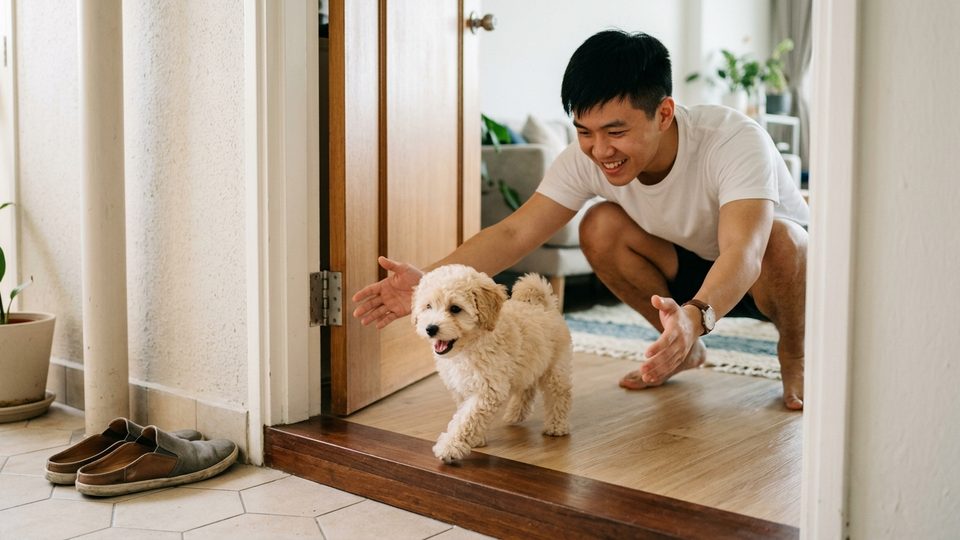
When can a puppy go home in Singapore?
About a week after its second core vaccination, at around week 9 of age. The core schedule runs at weeks 6, 8 and 12 with deworming at every visit, so a week-9 puppy goes home protected by two jabs and finishes the third with its new owner's vet.
How old should a puppy be when you get it?
About week 9 in Singapore. That is not a house preference and it is not a compromise: it is what falls out of the vaccination course once you put the dates in order.
Which is worth saying, because how old should a puppy be when you get it is answered almost everywhere else at 8 weeks. That answer is sound where it applies. The dates simply land differently here.
Why the date is arithmetic rather than opinion
Why the gap after the second dose matters
Protection is still building in the days after a dose, and a house move is the single largest change of environment a puppy has met. Putting the move a week after the second dose rather than on the day of it is the whole of the reasoning.
Why week 12 lands with you
Deliberately. It puts a veterinarian’s hands on the puppy inside its first month at home, continuing the health record the farm started, and it means somebody independent of the seller looks at the animal you bought.
Is 12 weeks too old to get a puppy?
No. The related searches ask this four different ways, at 12 weeks, 16 weeks and 4 months, and the answer does not change: later is a different first month, not damage.
What changes is which questions are worth asking. How old should a puppy be when you get it matters far less at this end of the range than what it has already met: a puppy handled properly in the weeks you missed is not behind, and one that has met nothing is.
Is 4 months too old to get a puppy?
No. A four-month-old is past the earliest socialisation window but well inside the age at which dogs settle into new homes. Ask what it is used to, what it has met, and what it has not, and plan the first month around the gaps.
What is the 10-10-10 rule for puppies?
A socialisation prompt: ten new people, ten new places, ten new surfaces or experiences in the early weeks. It needs adapting here, because the vaccination course is not finished at homecoming and shared ground in an HDB flat block is a question for your vet rather than a default.
What is the naughtiest age for puppies?
Most owners nominate adolescence rather than the puppy weeks, somewhere from around six months, when a dog that had learned everything appears to forget it. It is normal, it passes, and it is a training question rather than a homecoming one.
What happens before and after homecoming
Before homecoming, on the farm
Two core doses with deworming at each, a vet health check and microchipping. Between those visits comes the unglamorous work at the breeding farm: daily handling, crate training familiarity, household noise, stairs and car rides.
After homecoming, with you
- The health record travels with the puppy, with the dates written in it. Handle it yourself rather than being shown a photograph of it.
- The week-12 dose is yours to book, and booking it early beats booking it at week 12.
- An AVS dog licence is required, annually, once the dog is yours.
- Ask when to get the dog neutered. It is a conversation for a later appointment, and your vet sets the timing rather than a page.
- Toilet training starts on day one, in the spot you intend to keep, which matters more in a flat than the spot itself.
Who does what, and when

The schedule that sets the date
Week 6 brings the first core vaccination and deworming. Week 8 brings the second, with deworming again.
Protection is not instant. The immune response needs roughly a week after that second dose to build, which is exactly the week the puppy spends finishing its farm routine before homecoming. Getting a puppy any earlier costs it that week.
Week 12's third vaccination then happens with you, an optional fourth at week 16 follows if your vet advises it, and the booster runs annually from year one. The full first-year calendar is in our puppy vaccination schedule.
Why not week 6 or 7?
The immunity gap
A puppy between jabs one and two is at its most vulnerable to parvovirus and distemper, and a house move, new floors, new hands, new stress, is maximum exposure at minimum defence. Waiting one week past the second jab closes most of that gap before the puppy ever leaves.
The littermate classroom
Weeks 6 to 8 with mother and siblings are where a puppy learns bite inhibition and dog manners. Those lessons cannot be taught later by a human; a puppy removed early often shows it for years in mouthing and poor dog-to-dog reading.
Which makes handover age a seller-quality test you can run in one question: how old will the puppy be at collection, and can I see the vaccination booklet?
Getting a puppy is one of the few purchases where the date on the paperwork is the whole argument. Count the weeks yourself.
A seller offering a 6-week-old is saving on jabs, board and patience, all at the puppy's expense. Getting a puppy at 8 weeks here would mean moving it on the day of its second dose, which is the one day you would not choose.
What the first nine weeks of puppy care look like when they are done properly is in inside an AVS-licensed farm.
Week by week: the whole first-twelve-weeks map
| Age | What happens | Whose watch |
|---|---|---|
| Weeks 0–3 | Nursing, warmth, weight gain; eyes and ears open; first handling | Farm |
| Weeks 4–5 | Weaning begins; littermate play starts teaching bite inhibition | Farm |
| Week 6 | 1st core vaccination + deworming; vet health check | Farm |
| Week 7 | Socialisation window wide open: sounds, surfaces, crate, car rides | Farm |
| Week 8 | 2nd core vaccination + deworming | Farm |
| ~Week 9 | Immunity from jab two consolidates; homecoming | Handover |
| Weeks 9–11 | Settling (the 3-3-3 pattern), home routine, safe indoor socialisation | You |
| Week 12 | 3rd core vaccination + deworming, with your vet | You |
An optional fourth vaccination at week 16 may follow if your vet advises it, and the core booster is annual from year one.
Your first 48 hours after the handover
The week-9 date does half the work. Your first two days do the rest.
- Keep the world small: one room, the crate, the toilet spot.
- Keep the food the same as the farm fed. Switching kibble on day one buys you diarrhoea on day two.
- Expect the first night to be loud and the third to be quieter.
- Visitors can wait a week. The puppy has just lost its littermates and does not need an audience.
The crate-beside-the-bed approach in our night-crying guide shortens the arc, and it is written for a flat rather than a house.
Book the week-12 vet visit in these 48 hours too, while the vaccination booklet is fresh in your hand.
That appointment finishes the core series, puts an independent professional's eyes on your purchase within its first month, and starts the relationship your dog will lean on for the next decade.
Whatever age to get a puppy you settle on, that visit is the one to book early. The full first-year calendar, including the licence that runs alongside it, is in the vaccination schedule guide.
48-hour checklist
- One room, crate, toilet spot only
- Same food as the farm fed
- Crate beside the bed, night one
- Week-12 vet visit booked
- Visitors postponed a week
Where the information on this page comes from
- The vaccination weeks: the canonical figures used across this site, core doses at weeks 6, 8 and 12, an optional dose at week 16, and an annual booster from year one. They are quoted rather than paraphrased, because a paraphrased health schedule is how a wrong one gets into circulation.
- The first nine weeks: first-party, from the AVS-licensed farm that raises the puppy. What happens between the doses is puppy care nobody outside the farm sees.
- Why the local answer differs: arithmetic, not disagreement. The overseas guidance you will find on this search recommends 8 weeks and is sound in its own context. Here the second dose falls at week 8, so getting a puppy at that age would mean moving it on the day of the jab. Nothing on this page says any welfare body is wrong.
- Licensing: AVS, which licenses the farm and issues the dog licence you will need once the dog is yours.
- What we deliberately do not publish: any figure on how often puppies are rehomed too early, or any claim about enforcement. We hold none we can source, and an invented number on a welfare question would be the worst kind of filler.
- What this page will not do: use handover age as an attack on any named seller. The age is a question you can ask anybody, and the answer is worth more than our opinion of them.
Information last checked 26 August 2026.
Litters approaching their week-9 homecoming are on our puppies for sale in Singapore page, with the vaccination dates for each puppy.
Homecoming timing, answered
When can a puppy go home with a new owner?
Why not take a puppy home at 6 or 7 weeks?
Is it a red flag if a seller offers a 6-week-old puppy?
Why does the week-12 vaccination happen with the new owner?
What if I cannot collect the puppy at week 9 exactly?
When can my new puppy meet other dogs and go outside?
Does the week-9 timing change for different breeds?
How old should a puppy be when you get it?
Can you get a puppy at 6 weeks?
Is 4 months too old to get a puppy?
What is the 10-10-10 rule for puppies?
What should be ready before the puppy arrives?
"But overseas breeders hand over at 8 weeks": the timing debate, settled
Eight weeks is the number most international guides quote, and it is sound in its own context rather than wrong. The convention marks the earliest age most jurisdictions consider separation acceptable, and it says nothing about vaccination timing.
Singapore's schedule puts the second core dose at week 8 itself, and immunity from any vaccination needs roughly a week to consolidate.
Take a puppy home a week earlier and it changes homes at the exact trough of its protection, into an environment full of new surfaces. Waiting costs seven days and buys the consolidation window.
Which is why, when people ask how old should a puppy be when you get it here, the answer is week 9 rather than the number they read somewhere else.
The week-9 handover also moves one vaccination into your ownership on purpose.
- All three doses before handover, at week 12 or later, gives you a more finished puppy but loses the early vet relationship and four weeks of the socialisation window at home.
- Handover before the week-8 dose means you inherit a medical schedule mid-stream, at maximum risk.
- Week 9 is where the immunity arithmetic, the socialisation window and the vet-handover logic all cross.
That is why it is our standard rather than our marketing, and it is the same answer we would give about getting a puppy from anybody else.
Whoever you buy from, make the timing part of your verification: date of birth on the paperwork, jab dates in the booklet, handover date in the chat history. Sellers who get this one date right tend to get the invisible things right too, the pattern our verification walkthrough is built on.